

Can One Inverter Run Multiple Motors?
In industrial electrical installations, the question “Can one inverter run multiple motors?” is a common concern for many technicians. The short answer is Yes. Using one inverter (VFD) to control 2, 3, or even 10 motors simultaneously is a very common solution today to optimize costs. However, for the system to operate durably and avoid fire risks, you must master the following technical principles:
1. Common Applications
This method is typically applied to systems with synchronous operation characteristics, such as:
-
Ventilation fan arrays in livestock farms.
-
Roller conveyor systems in manufacturing.
-
Parallel water pump systems.
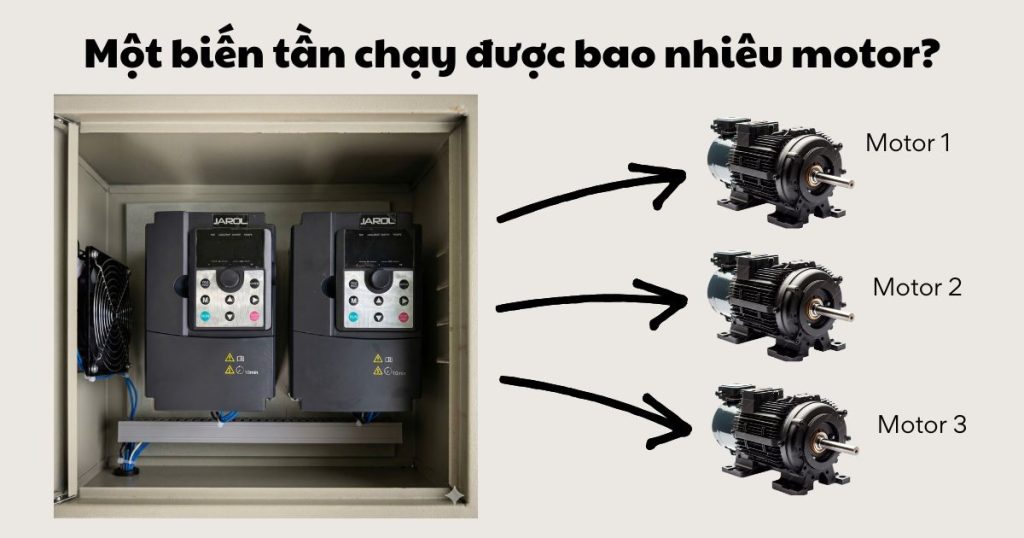
2. 4 Mandatory Technical Principles to Prevent Fire and Explosion
Although economically beneficial, inverters are originally designed for 1-on-1 optimization.. When using one for multiple motors, you must comply with these rules:
Principle 1: Select Inverter Capacity Based on Total Load
This is the most important note. The inverter capacity must not be chosen based on the single largest motor; it must be able to withstand the total load of all motors combined.
Practical Example: A system has 3 motors, each consuming 5A. > -> Total current: 5A + 5A + 5A = 15 A
Requirement: The inverter must have a minimum current rating of 16–17A or higher to ensure safety.
Principle 2: The “Sync in, Sync out” Rule
When sharing an inverter, all motors receive the same frequency parameter. This means they will:
-
Start and stop together.
-
Accelerate, decelerate, and run at the same speed together.
Note: You cannot adjust Motor A to run at 30Hz while Motor B runs at 40Hz.
Principle 3: Mandatory Individual Protection for Each Motor
This is a common mistake leading to equipment failure. When running multiple motors, the inverter only reads the total current of the entire system.
-
If one motor gets jammed, its current will spike.
-
However, if the system’s total current hasn’t exceeded the inverter’s protection threshold, the inverter will not trip.
-
Result: Only the jammed motor will burn out.
Solution: You must install a thermal relay or individual Circuit Breaker (CB) to protect each motor.
Principle 4: Do Not Use for Overly Complex Loads
If your motors require independent control or have constantly changing, unstable loads, a shared inverter solution is no longer effective. In this case, it is best to have one inverter per motor to ensure performance.
3. Summary
Using one inverter for multiple motors is an effective budget-saving strategy. However, if you do not clearly understand and follow the technical principles above, you might save money on the inverter but lose much more on repairing burnt motors.
Hopefully, this article has given you the clearest understanding of variable frequency operation for various facilities. Wishing your system continued safe operation!